
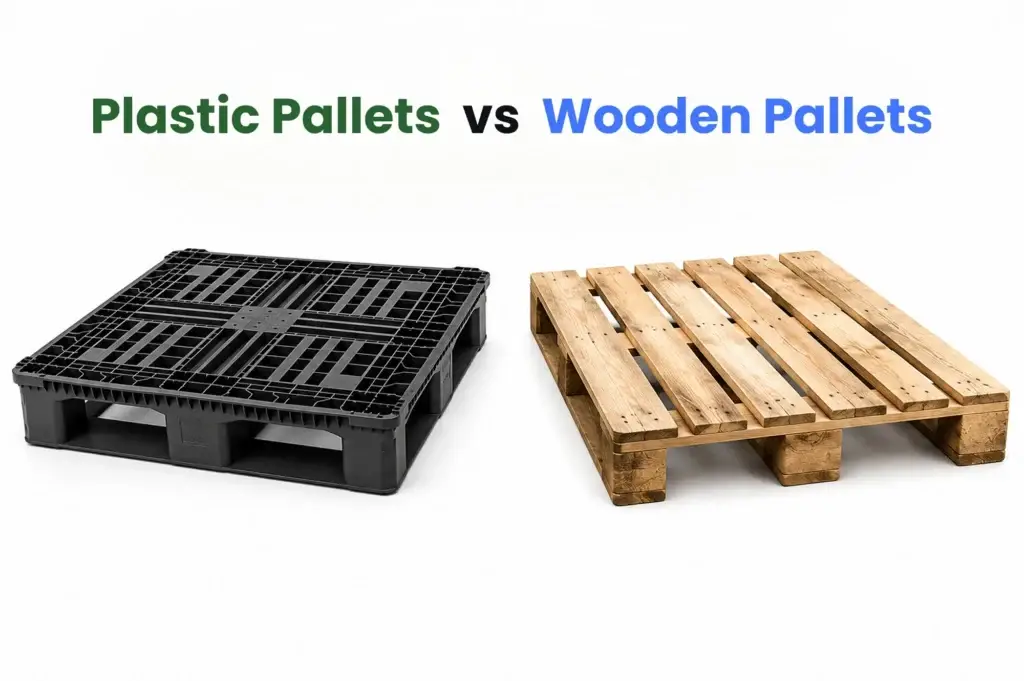
When comparing plastic pallets vs. wooden pallets, there’s no universal winner. The right choice depends on how your pallets are used, the products you handle, your shipping methods, and long-term operational goals.
While wooden pallets remain a cost-effective choice for many businesses, plastic pallets have become increasingly popular in industries that prioritize hygiene, durability, and automation. If you’re deciding between the two, this guide will compare their strengths, limitations, and ideal applications so you can invest in the right pallet for your business.
What’s the Difference Between Plastic Pallets & Wooden Pallets
At first glance, plastic and wooden pallets perform the same job; they provide a stable platform for storing, handling, and transporting goods. However, the material they’re made from affects everything from durability and maintenance to hygiene and shipping costs.
Material & Construction
Wooden pallets are assembled from hardwood or softwood boards using nails or staples. Their natural construction makes them strong and easy to repair, but slight variations in wood density, weight, and dimensions are common.
Plastic pallets are typically manufactured from high-density polyethylene (HDPE) or polypropylene (PP) using an injection-molding process. This creates a one-piece pallet with consistent dimensions, weight, and load performance across every unit.
Hygiene & Moisture Resistance
Because wood is naturally porous, it can absorb moisture, spills, and odors over time. Without proper storage and maintenance, prolonged exposure to moisture may increase the risk of mold, bacteria, or pest activity.
Plastic pallets have a non-porous surface that resists moisture, chemicals, and contaminants. They can be washed and sanitized more easily, making them a preferred choice for food processing, pharmaceuticals, and other hygiene-sensitive environments.
Durability & Workplace Safety
With repeated use, wooden pallets may develop splinters, cracked boards, or exposed nails. While these issues can often be repaired, damaged pallets should be removed from service to help protect workers and products.
Plastic pallets don’t splinter or contain fasteners, resulting in smooth surfaces and consistent handling. However, if a plastic pallet suffers significant structural damage, it typically needs to be replaced rather than repaired.
Performance in Warehouses
Because wooden pallets are assembled from natural materials, slight differences in size or wear can occur over time. While this is rarely an issue in traditional warehouses, heavily worn pallets may require more frequent inspections in highly automated operations.
Plastic pallets are manufactured to consistent dimensions and maintain their shape through repeated use. Their uniform design makes them well suited for conveyor systems, automated storage and retrieval systems (AS/RS), and other high-volume material handling equipment.
How to decide between plastic and wooden pallets
Choose Plastic Pallets if…
- You manage a food or beverage facility.
- Your pallets are frequently exposed to moisture, spills, and routine washdowns. Plastic pallets are easier to clean and sanitize.
- You operate a closed-loop distribution system.
- When pallets are returned, reused, and circulated within your own supply chain, plastic pallets can help reduce replacement frequency and maintenance over time.
- You regularly ship products internationally.
- Plastic pallets don’t require ISPM-15 heat treatment, helping simplify export logistics and reduce compliance concerns for international shipments.
Choose Wooden Pallets if…
- You primarily ship products one way.
- If pallets are unlikely to return after delivery, a lower-cost wooden pallet is often the more economical choice.
- You’re purchasing pallets in large quantities on a limited budget.
- Wood pallets provide a lower upfront investment, making them ideal for businesses focused on immediate cost savings.
- You need custom-sized pallets.
- Wood is easier to modify and manufacture in custom dimensions, making it a practical option for businesses shipping oversized or uniquely shaped products.
Plastic pallets vs wood pallets: pros and cons
The right pallet depends on your budget, operational requirements, and how frequently your pallets are reused. Here’s a side-by-side comparison of the key differences to help you determine which option best fits your business.
| Feature | Plastic Pallets | Wooden Pallets |
|---|---|---|
| Upfront Cost | Higher initial investment | Lower purchase price; ideal for budget-conscious operations |
| Long-Term Value | Long lifespan with minimal maintenance | Lower upfront cost but may require more frequent repairs or replacement |
| Durability | Resistant to moisture, chemicals, and weathering | Strong and durable but can crack, splinter, or warp over time |
| Load Capacity | Consistent performance for light to heavy loads (varies by design) | Excellent strength for heavy-duty industrial applications |
| Hygiene | Non-porous, easy to clean, and sanitize | Porous surface can absorb moisture and contaminants |
| International Shipping | No ISPM-15 heat treatment required | Must meet ISPM-15 regulations for most export shipments |
| Best For | Food & beverage, pharmaceuticals, export logistics. | Manufacturing, construction, domestic shipping, heavy-duty and one-way distribution |
Conclusion
You already have enough priorities to manage across your supply chain, without having to worry about whether the pallets are up to the task. The right foundation should support your operation, not create additional challenges.
Whether plastic or wood is the better choice, investing in the right pallet solution helps your business work better. Instead of settling for a one-size-fits-all solution, choose the pallet that aligns with your needs. B&G Industries